

How To Repair A Guitar Bridge
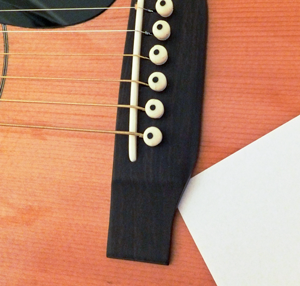 The audio-visual guitar span serves many functions on the guitar. It non just sets the placement of the strings, the span besides plays a crucial role in expert tone, action, and intonation. That is why it is of import to understand how your acoustic guitar bridge works and how to maintain it.
In this article, I'll hash out acoustic guitar bridge construction and purpose, how a span can intermission, and how to set up it so your guitar can play cracking once again. Permit's first take a look at what an audio-visual guitar bridge does and how information technology is made.
Guitar Bridge Repair Tools Y'all Will Need
Contents
- 1 Guitar Span Repair Tools You Will Need
- 1.ane Acoustic Guitar Span Repair Tool Kit
- 2 What does an Acoustic Guitar Bridge do?
- 2.one Action and intonation
- two.ii Audio-visual Guitar Caryatid
- iii Acoustic Guitar Bridge Construction
- 3.1 Acoustic Guitar Wood
- four What causes a guitar bridge to break or go loose?
- 4.1 Acoustic Guitar Dryness and Humidity
- 4.two Guitar Temperature
- 4.3 Guitar Humidity
- 4.4 Improper Gluing
- 4.5 Cracked and Warped Bridges
- 4.6 Croaky Guitar Bridge Plates
- 5 How to Set up a Loose Acoustic Guitar Bridge
- 5.1 Diagnose the Trouble
- 5.2 Remove the Bridge
- 5.two.ane Heat up the Gum
- 5.2.ii Pare away the Bridge
- 5.3 Clean the Joint
- 5.iii.one Make clean the Body
- 5.3.ii Clean the Bridge
- 5.4 Bridge Placement
- five.5 Dry out Run
- 5.6 Mucilage the Guitar Bridge
- five.7 Wipe off the Excess Mucilage
- 6 Related articles:
Here is a list of audio-visual guitar bridge repair tools that you lot will need to do almost repairs on your audio-visual guitar.
Acoustic Guitar Bridge Repair Tool Kit
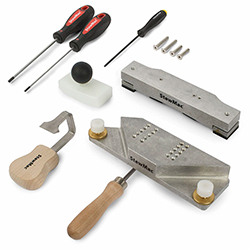 Hither is a complete set of tools for doing the well-nigh common audio-visual guitar bridge repairs. Information technology includes all the tools to steam and remove the bridge too every bit tools to clench and mucilage it back on the guitar. This set is a must have.
Check Current Price!
What does an Acoustic Guitar Bridge do?
Action and intonation
The obvious answer is that information technology holds the strings in the body. Yes, that is truthful, but a bridge does much more than that. The span non only holds the strings securely in the guitar torso, it also sets the string spacing. A modest change in the string spacing can drastically change the unabridged feeling of the musical instrument. Maybe even more important than string spacing, the guitar bridge sets the intonation of the guitar. Depending on the position or the bridge and saddle, the guitar might accept perfect intonation or might not be able to be tuned properly. The angle and position of the saddle slot in the span is key to setting the intonation of any guitar.
The acoustic guitar bridge also plays a large role in setting the string height or activeness of the instrument. The guitar saddle sets the action of the guitar by sitting in the saddle slot of the bridge. I wrote a three-footstep process to setting the action on an acoustic guitar. Check out the activity page for more info about how to lower the activity on an acoustic guitar.
Acoustic Guitar Brace
The bridge also acts as a brace to reinforce the guitar body. Since most audio-visual guitar braces are on the inside of the guitar, yous may have never thought of the bridge beingness an external brace. Internal guitar braces help support the load from the tension of the guitar strings. The span does the aforementioned thing just on the outside of the body. Have a look at the acoustic guitar brace patterns page for more details near guitar braces.
Acoustic Guitar Bridge Construction
Acoustic Guitar Woods
Acoustic guitar bridges are traditionally made out of dumbo woods like ebony and rosewood. Pretty much all high-end guitars accept ebony bridges. Dense wood is traditional considering of its structure, strength, and tone. Acoustic guitar bridges take a lot of abuse from the guitar strings. Information technology is of import to have a material that will concord up after years of playing.
Since acoustic guitar bridges are small, they are usually carved out of a single piece of wood. There are many different configurations of audio-visual bridges. Some bridges require pins to hold the strings in place while other string-thru designs hold the strings in place by the string balls. Saddle designs too vary amongst guitars. Some acoustics have multiple saddle pieces while others have directly or compensated saddles.
Even though there is a great deal of variation in acoustic guitar span design, the basics are the same. It is a solid piece of wood that is glued directly to the summit of the guitar. Direct gluing is important. If you are trying to re-glue a bridge, make certain y'all completely remove all the cease, old mucilage, and droppings earlier you try to mucilage the span dorsum on. I'll talk more than about this later in the commodity.
What causes a guitar span to break or get loose?
There are many dissimilar reasons why an acoustic guitar bridge can break, cleft, or split from the body. The two main reasons are improper environmental conditions and abuse.
Audio-visual Guitar Dryness and Humidity
Like with whatever guitar, the surrounding environment plays a big roll in the life of the guitar. Any form of astringent atmospheric condition tin exist traumatic to your guitar whether it is hot, cold, humid, or dry. Environmental changes cannot but ruin the cosmetic appearance of your guitar like cracks in the stop; it can likewise harm the structural integrity of your guitar.
Guitar Temperature
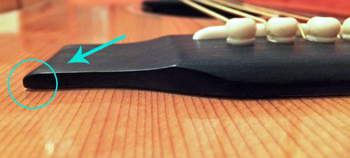 Excessive heat can heat up the glue on your acoustic guitar braces causing them to come loose from the body. If the braces are not properly connected to the top of the guitar, your guitar meridian can warp from the string tension. This is ane crusade of a loose bridge. If the X-braces become loose and stops providing support for the summit, the pinnacle usually caves in and places most of the string tension the bridge. Since the bridge isn't designed to agree this much weight it can beginning to peel away from the body.
Excessive oestrus tin can also heat the gum articulation up of the bridge itself. If the guitar gets too hot, the glue holding the bridge in place will slowly soften causing the string tension to pull the span forward (toward the sound hole). As I mentioned earlier, bridge placement is a key factor in proper intonation. If the bridge starts sliding forwards, your guitar's intonation might become messed up too.
The moral of the story is never leave your guitar in a hot car during the summertime. It doesn't thing how long you have to come across the shop or go pick something up. Don't do it. A car in the summer is a greenhouse just waiting to melt your guitar. Keep an eye on your acoustic when you travel during the summer and you can avoid well-nigh of these temperature related issues.
Guitar Humidity
Humidity is only as unsafe to guitars equally farthermost temperature shifts and swings. Humidity tin crusade the guitar forest to nifty or shrink and crevice the stop. High humidity will allow your guitar to blot more than moisture out of the air. The guitar woods will fill up up with water and expand while the hardened finish on the guitar will stay a constant size. The expanding of the wood can crack the finish.
High humidity is definitely and issue with audio-visual guitars, only depression humidity is what ruins guitar bridges. Low humidity has the opposite effect on electric guitar wood. The guitar wood dries out and shrinks while the hardened finish maintains the aforementioned shape. If a guitar is dry enough, the top volition turn into a concave shape bowing down in the middle where the bridge is glued. This can cause the bridge to come up loose. Most luthiers agree that an platonic humidity is around fifty%. It can be a fiddling more or a picayune less, merely this is a expert rule of thumb. During dry winter months, you may demand to place a humidifier in your guitar example in guild to maintain the humidity around 50 percent.
Improper Gluing
In order for any glue joint to hold up under extreme pressure level, it has to be prepped and cleaned properly. The same is true near guitar bridges. If the top of the guitar wasn't cleaned and sanded properly before the bridge was glued on, you lot might have a problem with this later on. This can happen when someone wants to replace his or her span with another 1. Instead of properly cleaning the top of the guitar they just rip off the old 1 and glue on a new 1. Nigh probable there is nevertheless end on the guitar elevation and the new bridge won't properly adhere to the guitar body.
Cracked and Warped Bridges
Commonly guitar bridges don't have a problem cracking or warping because they are glued to the guitar pinnacle. Unfortunately, once the bridge has pulled away from the body, it doesn't have the support of the guitar. While the bridge is peeling abroad from the torso, information technology can warp from the tension of the strings or even scissure. Cracks tin can also happen from extremely dry out conditions.
Cracked Guitar Bridge Plates
The bridge plate is a brace or plate that is glued directly under the bridge to aid back up the tension of the guitar strings. It is not uncommon for these to have the aforementioned problems every bit the span. A cracked bridge plate ordinarily has to exist replaced instead of reglued.
How to Fix a Loose Acoustic Guitar Bridge
Now that we have covered the possible issues, let'due south accept a look at how to ready your guitar bridge.
Diagnose the Problem
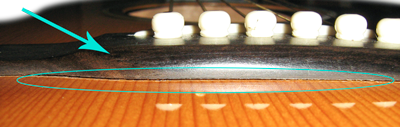 If your bridge is loose or cracked, you volition need to remove it from the body and re-mucilage information technology or replace it. Take a look at the back of the bridge. Can you run across a gap in between the bridge and the body? If and then, it has come up loose. Sometimes the gap is and so small that you tin can't see if easily. Have a piece of paper and slide it between the bridge and the torso. If the bridge is properly glued, the newspaper shouldn't exist able to become between them.
Once you determine that yous have to remove the span, get a card stock piece of paper and trace the bridge out on it. Then cut the span out of the newspaper. You can identify the piece of paper down effectually the bridge like a guard while you lot are removing information technology to protect the stop.
Remove the Bridge
Heat up the Glue
After you have taken a loose at your loose bridge, you will nigh likely need to remove the whole affair. There are many ways to do this. You can place a heating pad on top of the span for a infinitesimal or so to estrus the glue upwardly. If you don't want to buy a heating pad, you tin can likewise use a wearing apparel fe with a towel to cover the bridge. Which ever you apply, be very careful. You don't desire to rut the guitar top up too much. You lot could cause the braces to come loose or damage the finish on the top of the guitar.
Peel away the Bridge
After the glue is warm and loose, y'all can accept a flexible, blunt putty knife and piece of work it between the span and the body. Be conscientious not to damage the stop in the process. You may have to heat information technology a few times to go the putty knife all the way across the span. Only have everything nice and boring. You don't want to over heat things and yous don't desire to slip with the pocketknife.
Make clean the Joint
Make clean the Body
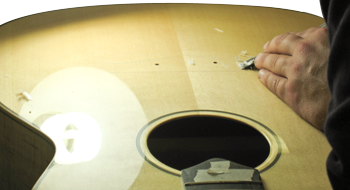 Clean the forest is ane of the almost of import steps when gluing anything. First, you have to know exactly where to make clean. I like to line the bridge up with dowel pins (similar I talk well-nigh in the next section) and place the bridge on the guitar with double stick tape. This secures the bridge in identify. Now I have a scribe or X-acto knife and cut a line in the cease effectually the bridge. Later on you score the finish, yous tin can have some masking tape and outline the body around the bridge. This will protect the finish during the cleaning process.
Next, y'all can remove the bridge and start cleaning the guitar top. I unremarkably utilize a chisel to scrape off the excess glue on the guitar superlative. Make certain not to slip with the chisel. Y'all merely want to remove the glue and finish from underneath the bridge.
Make clean the Bridge
Cleaning the span is just as important equally cleaning the body. You can use some sand paper to remove the glue on the bottom of the bridge. Since the top of the guitar is bent into a slight radius, yous will need to match that with the bridge. Acoustic guitar tops are made with all types of radii ranging from 15′ to 100 human foot. Mensurate the radius of your guitar top and buy a matching radius block. Y'all can put stick sand newspaper on the radius block to sand the perfect shape into the span.
Bridge Placement
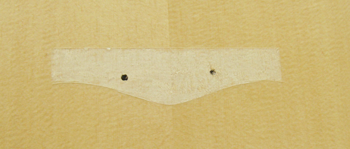 It is extremely important to line your bridge up properly before your glue information technology downwardly. Otherwise, you lot might have to redo everything. I similar to measure out and marking the centerline of the bridge on the bottom and front side. That mode I can line up the centerline on the bridge with the centerline of the guitar body.
Since this is the not the first time a span has been glued on the guitar, there will be bridge pin holes drilled in the top of the guitar. I place a wooden dowel in the commencement and last string holes of the span to line it up with the placement of the onetime bridge. Once the bridge is glued in place, the dowels tin be drilled out. The pic to the left is of a guitar that I built. As yous can come across, the offset and concluding cord holes have been drilled for dowel placement.
Dry Run
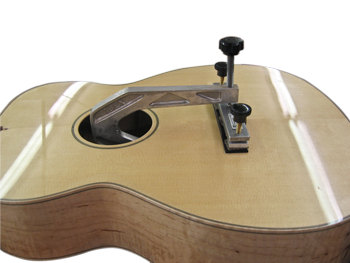 Once the bridge and the body are completely cleaned, you should clamp them together without any glue. I phone call this a dry run. Whenever you are gluing anything important on a guitar, you should do a dry run. That style you will run into if your clamping idea, cauls, and clamps fit properly. Trust me; you don't want to put glue on the guitar get it all clamped upwardly and discover out that something is wrong. You volition exist scraping glue off the stuff you just cleaned.
Y'all'll demand a deep c-clamp in order to clamp the bridge in place. You volition as well want to make a special caul that will fit the inside of the guitar on the span plate between the X-braces. This way you lot can create the proper corporeality of pressure with out destroying annihilation. I commonly just cutting and shape a ane×iv board to fit in betwixt the Ten-braces.
Gum the Guitar Bridge
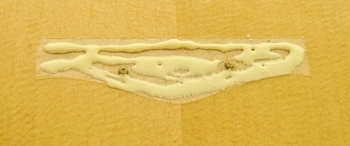 After a successful dry run, y'all can apply the glue. I use Titebond forest glue. On near glue joints I say to go sparingly on the glue–not this joint. The bridge has to exist deeply jointed with the body.
Brand sure to put a good amount of gum on the body and clench the bridge downwards just similar the dry out run.
Tighten down the clench until you commencement to see a good amount of glue squeezing out of the seam.
Wipe off the Backlog Glue
I usually use a damp textile or paper towel to wipe off the excess squeeze out. Make sure to wipe information technology away immediately. You don't desire it to harden and ruin the end. I usually like to allow the span gear up over dark. This fashion in that location is enough of time for the glue to dry. Take the clamps off the adjacent day and you are fix to restring your guitar. Only brand certain to be conscientious removing the clamp and caul. Information technology is very like shooting fish in a barrel to dent the inside of the sound hole with a deep c-clamp.
Now your bridge is re-glued and ready to be strung up. Time to restring your guitar and get-go playing once again.
Related articles:
- How to remove guitar frets
- How to finish an electric guitar
- How to fret an electric guitar
- What glue should I utilize to glue in fretboard binding
- How to fix acoustic guitar bounden around the torso

Source: https://www.guitarrepairbench.com/acoustic-guitar-repairs/bridge-repair/
Posted by: sturgillroure1979.blogspot.com
0 Response to "How To Repair A Guitar Bridge"
Post a Comment