

How To Repair Textbook Cover Scratches
Fixing damaged plastic bumpers involves grinding, sanding, sculpting and painting. But it's worth the effort for repairs that would price less than your deductible.
At that place oughta exist a law: If at that place's a post in a parking lot—whatever mail—it should be high plenty to meet when you're bankroll up. Unfortunately, the law nosotros commonly encounter applied is Murphy's, and the resulting body-harm repairs will price but a few dollars less than your insurance deductible. And that's precisely the scenario we were faced with after trying to maneuver our trusty Honda Civic out of a tight space in a crowded mall parking lot.

A lot of people would first try to do what you lot shouldn't: Head to the local auto parts shop for some el cheapo body filler and a tin of matching spray paint. Surprise! The engineering of auto body parts has changed—and you'll need a completely different array of supplies to repair painted plastic parts than you would employ to repair sheetmetal. Fortunately, there are a number of companies making repair and refinishing materials for plastic bumpers, as well as plastic fenders and door skins made from sheet molding compound.
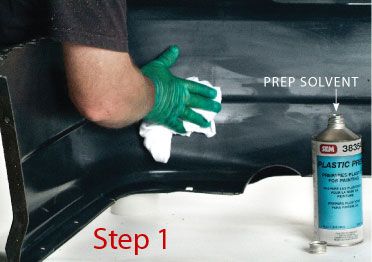
Scuff, clean and prep area with plastic prep solvent to remove dirt and oil, and promote adhesion.
Bumper Mechanics
Today, the actual "bumper" part of a forepart or rear bumper is invisible. The part of the machine'south structure that's used for saving the vehicle's trunk from damage is well hidden behind a adequately large semirigid piece of painted plastic. This plastic roofing is designed to deflect and deform easily when bumped. The theory goes that you tin can run into it lightly and the plastic will popular back into its original shape. Notwithstanding, actually wallop it, specially with a hard or sharp object, and the plastic will abrade, cut or tear.
Various carmakers use different methods of attaching these plastic bumper covers. Considering they are held in place with screws and tabs that fit into slots in the body sheetmetal, you may have to do some hunting effectually for all the fastening points of a typical fascia.
On our damaged Civic, for example, in that location were screws behind metal caps near the body latch, also as screws under the taillights and at the bicycle wells. One time they were removed, we were able to slide the bumper's tabs off a number of slots in the rear quarter panels. Look for screws or bolts under the body carpeting between the cycle and the rear bumper. You may also find fasteners hidden beneath or backside the bumper fascia.
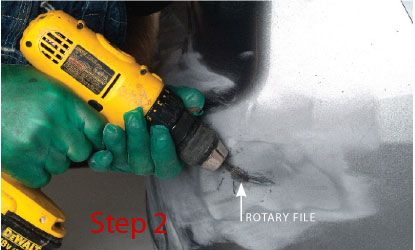
Grind a "Five" into the back of panel to remove loose material and requite more surface area for adhesion.
Fascia Facelift
You'll need a warm, dry place to work because the repair adhesives and fillers cure within a fairly narrow range of temperatures. If you have the fascia off the car, you can work indoors—but not in the basement considering these chemicals tin give off some pretty noxious fumes. Read the labels carefully.
Not all plastic bumpers are fabricated from the same stuff. But with the fascia removed, it'due south easy to place the type of plastic because it's stamped into the back side. Stamps of PP (polypropylene), PPO (polyphenylene oxide) and TPE (thermoplastic elastomer) indicate plastics that smear easily when footing or machine sanded. (Our Civic bumper is made of polypropylene.) Stamps of PUR (polyurethane plastic rigid) and TPUR (thermoplastic polyurethane elastomer) are plastics that powder when footing or sanded.
The blazon of filler you utilize to repair the bumper depends on the plastic blazon, and in that location are many different manufacturers. Consult with the counterman at the motorcar paint store for the appropriate products. While the specific brand yous use isn't critical, it is important that yous stay with that aforementioned brand throughout the entire repair to exist certain the products are uniform.
Regardless of plastic type, prepping the fascia is the same: Begin past slightly scuffing the damaged area and cleaning it with plastic surface cleaner. If the bumper is cut or torn through completely, brand certain to scrub the inner and outer surfaces. After rinsing and letting the surface dry, wipe the area with prep solvent. When wiping with this material, go in merely one direction because going in two directions simply drags contaminants back into the repair.
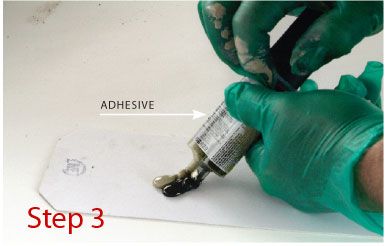
Thoroughly mix equal amounts of hardener and repair adhesive on a piece of cardboard or paper.
After the solvent has dried, sand the expanse past hand with 80-grit paper. Next, you'll need to form a "V" groove in the damaged expanse on the forepart and back sides of the fascia. The grooves allow you to align the two edges more easily. They as well provide more surface area for the repair textile to attach to.
For plastic types that powder when sanded, cut the grooves with a 24-grit disc on a sander. For plastics that smear when sanded, brand the grooves using a cordless drill and a rotary file. This gives you greater command and slower speeds to reduce the chance of heat-generated smears.
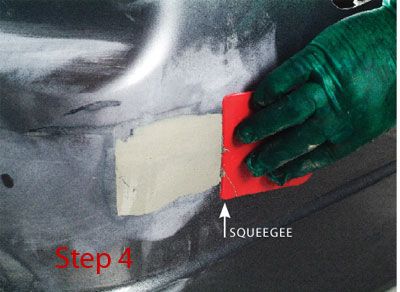
Spread plastic filler over the repair. Don't slop it on heavily or you lot'll have more work subsequently.
Repair tears and cuts from the back side of the fascia. If the cutting or tear is large, you might have to align and then concur the edges of the repair with masking tape on the front of the fascia. Utilize self-stick fiberglass-repair tape to add together structure to the cut or tear. Next, mix the agglutinative and apply it over the tape with a body-filler squeegee. When the first layer of record is in place, apply a second layer so the threads run at a ninety-degree angle to the get-go layer.
In one case the material has hardened (in about 20 minutes), movement to the front end of the fascia and remove any tape (if applied). Next, using 80-grit sandpaper, remove any material that has squeezed through, and sand any spots that are above the finished level of the fascia. Make full the cut or tear and any low spots in the forepart of the fascia with the appropriate repair material, and squeegee information technology level. After information technology has hardened, sand everything level, first with 80-grit, then 120-grit, and then utilise a light skim coat of repair fabric to fill pits and surface imperfections, and to restore the original profile. Then terminate sand with moisture 400-grit newspaper.
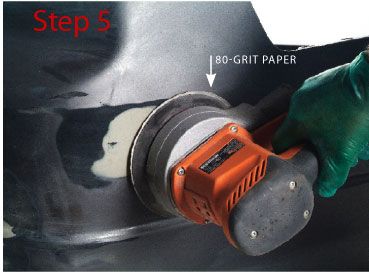
Sand and contour plastic body filler with 80- and 120-grit, then finish with 400-grit waterproof sandpaper on a rubber cake. Information technology volition probably take two coats to restore contour properly.
PAINTING THE PLASTIC
When the repair is completed, use ii wet coats of flexible part sealer. Later drying for 30 minutes, the fascia is ready for priming and painting. Again, read the labels and follow the maker'southward recommendations for operator safety—this stuff tin can exist very toxic if inhaled. Modern primers and basecoat/clearcoat paints are flexible enough to accommodate plastic bumpers without peeling or loss of adhesion. Prime the fender with ii coats of any ii-part primer-surfacer, making certain to let the primer dry betwixt coats. Once the primer has hardened, dry sand the repaired areas with 400-dust paper to level it and remove any imperfections.
Earlier spraying the bumper with basecoat, wetsand information technology and gently wipe the area with a tack rag to remove dust, and so spray according to the manufacturer's instructions. You may need to repeat this process 2 or three times to cover completely. In one case the basecoat is dry out (normally well-nigh thirty minutes), mix the clearcoat with hardener. Apply two medium clearcoats, assuasive each to dry out in betwixt.
After drying overnight, the fascia is prepare to be reinstalled. Once information technology's in identify, lightly wetsand the painted surface with 1500-grit newspaper to remove grit particles and surface paint imperfections. Avoid sanding through the pigment past staying away from creases and seams. When washed, dry the fender and wait for shiny areas, which signal that more sanding is needed. To bring out the luster of the pigment, utilise rubbing chemical compound on the cream polishing pad of a rotary buffing machine, still fugitive creases and seams. Go the final sheen using a fresh foam pad and polishing compound.
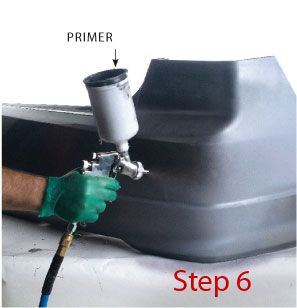
Before spraying the bumper with basecoat, wetsand it and gently wipe the area with a tack rag to remove dust, then spray according to the manufacturer's instructions. You lot may need to repeat this procedure 2 or three times to cover completely.
This content is created and maintained past a third party, and imported onto this page to help users provide their e-mail addresses. You may be able to detect more information most this and similar content at piano.io

Source: https://www.popularmechanics.com/cars/how-to/a650/2763656/
Posted by: sturgillroure1979.blogspot.com
0 Response to "How To Repair Textbook Cover Scratches"
Post a Comment